
COMPLEX BIOSYSTEMS
José Ricardo Arias González de la Aleja
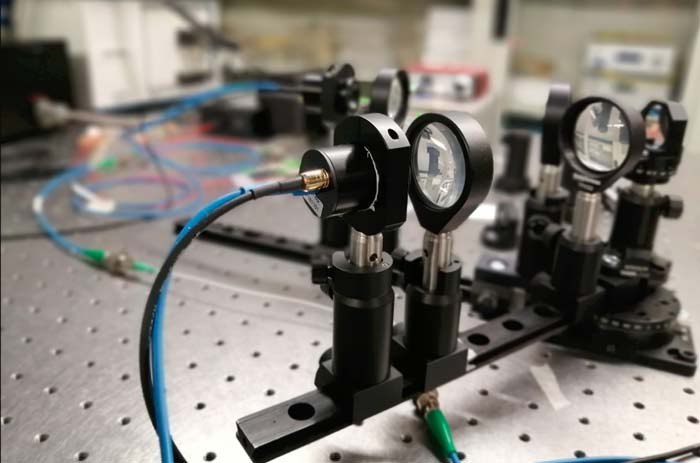
We investigate nanosystems of biological origin from a physical perspective, exploring the principles governing information, molecular function, and the emergence of complexity in living matter. Our research combines theoretical approaches from statistical physics, information theory, and stochastic processes with experimental methods in molecular biophysics and optical nanomanipulation.
A central focus is the Central Dogma of molecular biology, where we aim at examining how DNA and RNA structures act as physical carriers of biological information and how their molecular properties shape its storage, transmission, and expression. Through theoretical and experimental studies of these biomolecules and their associated protein hardware, we investigate the relationships between information, thermodynamics, molecular mechanisms, and function, including the physical origins of fidelity and error correction. Our research also encompasses the optical manipulation of functional nanostructures, connecting photonics with biocompatible systems for sensing and nanomedicine.
We seek to establish quantitative links between physical principles and biological complexity, combining molecular-scale experiments with theoretical frameworks to understand biological systems operating far from equilibrium.
Spin-based modelling of perception as emergent from contextualized internal evaluation
Fanfarillo, L.; Diez, G.; Gomez-Mayordomo, V.; Bosch, M.; Arias-Gonzalez, J. R.; Belen Valenzuela, B., “Spin-based modelling of perception as emergent from contextualized internal evaluation,” Royal Society Open Science, 13(9), 252221 (2026).
A writing protocol with ambiguity resilience in nanoscale systems
Arias-Gonzalez, J. R., “A writing protocol with ambiguity resilience in nanoscale systems,” The Journal of Chemical Physics, 163(2), 024123 (2025).
Optical Tweezers to Study Viruses
Arias-Gonzalez, J. R., “Optical Tweezers to Study Viruses,” in M. G. Mateu (ed.), Structural and Physical Virology, 2nd ed., ch. 10, Sub-cellular Biochemistry, vol. 105, pp. 359–399 (2024).
Fluctuation relations for irreversible emergence of information
Arias-Gonzalez, J. R., “Fluctuation relations for irreversible emergence of information,” Scientific Reports, 12, 17230 (2022).
Optical multi-trapping by Kinoform m-Bonacci lenses
Muñoz-Pérez, F. M.; Ferrando, V.; Furlan, W. D.; Monsoriu Serra, J. A.; Arias-Gonzalez, J. R., “Optical multi-trapping by Kinoform m-Bonacci lenses,” Optics Express, 30(19), 34378–34384 (2022).
Heat Generation in Single Magnetic Nanoparticles under Near-Infrared Irradiation
Rodríguez-Rodríguez, H.; Salas, G.; Arias-Gonzalez, J. R., “Heat Generation in Single Magnetic Nanoparticles under Near-Infrared Irradiation,” The Journal of Physical Chemistry Letters, 6, 2182–2187 (2020).
Photoluminescence Activation of Organic Dyes via Optically Trapped Quantum Dots
Rodríguez-Rodríguez, H.; Acebrón, M.; Iborra, F. J.; Arias-Gonzalez, J. R.; Juárez, B. H., “Photoluminescence Activation of Organic Dyes via Optically Trapped Quantum Dots,” ACS Nano, 6, 7223–7230 (2019).
Single-Stranded Condensation Stochastically Blocks G-Quadruplex Assembly in Human Telomeric RNA
Gutiérrez, I.; Garavís, M.; de Lorenzo, S.; Villasante, A.; González, C.; Arias-Gonzalez, J. R., “Single-Stranded Condensation Stochastically Blocks G-Quadruplex Assembly in Human Telomeric RNA,” The Journal of Physical Chemistry Letters, 9, 2498–2503 (2018).
Laser Heating Tunability by Off-Resonant Irradiation of Gold Nanoparticles
Hormeño, S.; Gregorio-Godoy, P.; Perez-Juste, J.; Liz-Marzán, L. M.; Juarez, B. H.; Arias-Gonzalez, J. R., “Laser Heating Tunability by Off-Resonant Irradiation of Gold Nanoparticles,” Small, 10, 376–384 (2014).
Mechanical Identities of RNA and DNA Double Helices Unveiled at the Single-Molecule Level
Herrero-Galán, E.; Fuentes-Perez, M. E.; Carrasco, C.; Valpuesta, J. M.; Carrascosa, J. L.; Moreno-Herrero, F.; Arias-Gonzalez, J. R., “Mechanical Identities of RNA and DNA Double Helices Unveiled at the Single-Molecule Level,” Journal of the American Chemical Society, 135, 122–131 (2013).
Active DNA Unwinding Dynamics during Processive DNA Replication
Morín, J. A.; Cao, F. J.; Lázaro, J. M.; Arias-Gonzalez, J. R.; Valpuesta, J. M.; Carrascosa, J. L.; Salas, M.; Ibarra, B., “Active DNA Unwinding Dynamics during Processive DNA Replication,” Proceedings of the National Academy of Sciences of the United States of America, 109, 8115–8120 (2012).
Plasmon-Exciton Interactions on Single Thermoresponsive Platforms
Hormeño, S.; Bastús, N. G.; Pietsch, A.; Weller, H.; Arias-Gonzalez, J. R.; Juárez, B. H., “Plasmon-Exciton Interactions on Single Thermoresponsive Platforms,” Nano Letters, 11, 4742–4747 (2011).
Temperature Control Methods in a Laser Tweezers System
Mao, H.; Arias-Gonzalez, J. R.; Smith, S. B.; Tinoco, I.; Bustamante, C., “Temperature Control Methods in a Laser Tweezers System,” Biophysical Journal, 89, 1308–1316 (2005).
Single-Molecule Spontaneous Emission Close to Absorbing Nanostructures
Thomas, M. L.; Greffet, J.-J.; Carminati, R.; Arias-Gonzalez, J. R., “Single-Molecule Spontaneous Emission Close to Absorbing Nanostructures,” Applied Physics Letters, 85, 3863–3865 (2004).
Optical Forces on Small Particles: Attractive and Repulsive Nature and Plasmon-Resonance Conditions
Arias-Gonzalez, J. R.; Nieto-Vesperinas, M., “Optical Forces on Small Particles: Attractive and Repulsive Nature and Plasmon-Resonance Conditions,” Journal of the Optical Society of America A, 20(7), 1201–1209 (2003).
SEE MORE «NANOPHOTONICS FOR HEALHT CARE AND SENSING» RESEARCHS
BIOPHOTONICS
Prof. Jaime García Rupérez
PHOTONIC TECHNOLOGIES FOR APPLIED ANALYTICS
Dr. Amadeu Griol Barres
| Name | José Ricardo Arias González de la Aleja |
| joargon1@upv.edu.es | |
| Phone | |
| ORCID | |
| Researcher ID | |
| Scopus ID | |
| Webpage / Social Networks |